
Author Guidelines
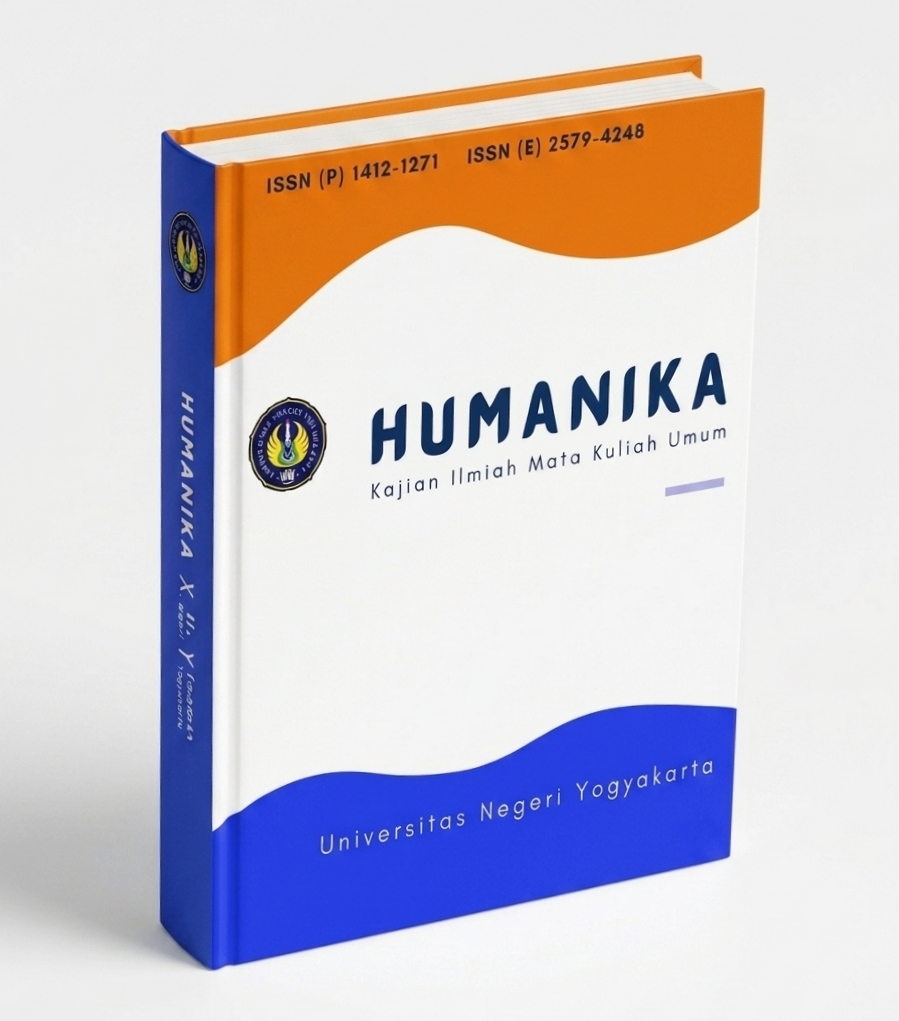
HUMANIKA · UNIVERSITAS NEGERI YOGYAKARTA
Author Guidelines
Writing for the journal.
What a manuscript must contain, how to prepare it, and how to submit it.
Guidelines for authors
These guidelines explain the manuscript requirements for Humanika: Kajian Ilmiah Mata Kuliah Umum, published by Universitas Negeri Yogyakarta. Authors are expected to prepare manuscripts that meet the journal's scope, academic standards, formatting requirements, and publication ethics policies.
Before submitting, authors should review the journal's current instructions, use the applicable manuscript template, and ensure that all required files and declarations are complete.
01
Before you start
- Check the scope. Ensure that the manuscript fits the journal's focus and scope. See HUMANIKA Journal.
- Choose the article type. Check the applicable requirements on the Manuscript Type page.
- Follow the manuscript format. Use the journal's official template where available and follow the latest formatting instructions.
- Read the publication policies. Review the journal's rules on authorship, plagiarism, competing interests, research ethics, and generative AI.
- Prepare for anonymous review. Remove identifying author information from the manuscript file if required by the journal's double-anonymous peer-review process.
02
Article types
HUMANIKA publishes scholarly manuscripts that contribute to the development of knowledge in its fields of interest. Authors should select the appropriate manuscript type before submission.
| Article type | Description |
|---|---|
| Original research article | Reports original empirical research using appropriate qualitative, quantitative, or mixed-methods approaches. |
| Review article | Provides a critical and systematic synthesis of relevant scholarly literature. |
| Conceptual article | Develops a theoretical argument, conceptual framework, or critical analysis of a significant scholarly issue. |
Authors must verify the accepted article types and applicable word limits on the journal's current Manuscript Type page.
03
General requirements
| Originality | The manuscript must be original, unpublished, and not simultaneously submitted to another journal. Previous dissemination must be disclosed where applicable. |
|---|---|
| Language | Use the language required by the journal. English manuscripts must use clear, accurate, and consistent academic English. |
| File format | Submit the manuscript in Microsoft Word format unless otherwise instructed. |
| Formatting | Follow the journal's current template for font, spacing, margins, headings, tables, and figures. |
| Title | Use a concise, informative title that clearly communicates the subject and contribution. |
| Abstract | Follow the word limit and language requirements specified in the current manuscript instructions. |
| Keywords | Provide relevant keywords that support indexing and accurately represent the manuscript's content. |
| References | Use the referencing style required by the journal and verify every citation and reference entry. |
| Research ethics | Provide relevant ethics approval and informed-consent information where applicable. |
04
Title, authors, abstract, and keywords
- Title. Use a specific and concise title that reflects the manuscript's main issue and contribution.
- Authors. Provide full names without academic titles, institutional affiliations, country, and email addresses.
- Corresponding author. Identify the author responsible for editorial correspondence and ensure that the contact details are valid.
- Abstract. Summarise the background, objective, method or analytical approach, principal findings or argument, and conclusion.
- Keywords. Supply the number of keywords required by the journal and choose terms relevant to scholarly indexing.
- Author approval. All authors must approve the submitted version and agree to the author order.
05
Structure of the manuscript
1. Introduction
Present the research background, problem, relevant literature, research gap, significance, objectives, and theoretical or conceptual foundation.
2. Method
Explain the research design, setting, participants or sources, selection procedures, data collection, and analytical methods in sufficient detail.
3. Results or Findings
Present findings systematically in relation to the research questions, objectives, themes, or analytical categories.
4. Discussion
Interpret the findings in relation to theories and previous research. Explain the significance, originality, implications, and limitations of the results.
5. Conclusion
Summarise the principal conclusions, answer the research objectives, and identify implications and directions for future research.
6. References
List all cited sources accurately and consistently according to the journal's required referencing style.
Review and conceptual articles may use a different structure appropriate to their analytical purpose.
06
Declarations and publication transparency
Authors must comply with the journal's applicable policies and provide all declarations required during submission.
| Acknowledgements | Recognise contributions from individuals or institutions that do not qualify for authorship. |
|---|---|
| Conflict of interest | Disclose financial and non-financial interests that could influence the research. State explicitly when no conflict exists. |
| Funding | Identify funding organisations, grant numbers, and the role of the funder where applicable. |
| Data availability | Explain where supporting data can be accessed or why sharing is restricted. |
| Ethics and consent | Provide ethics approval and informed-consent details where relevant to the research. |
| Author contributions | Describe each author's contribution to the research and manuscript. |
| Generative AI | Disclose AI use as required by the journal's Generative AI Policy. Authors remain responsible for all submitted content. |
| ORCID | Provide the ORCID iD of each author where requested. |
Authors should also review the journal's Authorship Policies and other relevant publication policies.
07
Tables and figures
- Number tables and figures consecutively in the order in which they are cited.
- Provide clear titles, captions, labels, legends, and explanatory notes.
- Ensure that figures are legible at publication size and that tables are easy to interpret.
- Refer to each table and figure in the manuscript text.
- Identify the source of reproduced or adapted materials and obtain permission where required.
- Submit original or editable figure files when requested by the editorial team.
08
Citations and references
- Apply the referencing style specified in the journal's current author instructions or manuscript template.
- Ensure that every in-text citation appears in the reference list and that every reference-list entry is cited in the text.
- Prioritise relevant, reliable, and current scholarly literature while retaining seminal sources where appropriate.
- Verify the spelling of author names, publication years, article titles, journal titles, volume, issue, pages, and DOI.
- Present DOI information as a complete link, such as
https://doi.org/10.xxxx/xxxxx, whenever available. - Use reference-management software where appropriate to improve consistency and accuracy.
09
Preparing the submission files
Before uploading, ensure that the following files are ready:
- Anonymised manuscript: the complete manuscript without identifying author information when anonymous review is required.
- Title page: the title, author names, affiliations, email addresses, and corresponding-author details, if requested separately.
- Supplementary files: instruments, appendices, datasets, or other relevant supporting materials, if applicable.
- Declarations: all required ethics, authorship, funding, conflict-of-interest, and AI-use statements.
- Final checks: remove template instructions, comments, tracked changes, highlighted placeholders, and unnecessary identifying metadata.
10
Submitting your manuscript
- Register or log in. Access the journal through the official HUMANIKA website.
- Read the submission instructions. Check the current requirements and prepare all mandatory files.
- Upload the files. Submit the manuscript and any required supplementary documents through OJS.
- Complete the metadata. Enter the article title, abstract, keywords, and all author information accurately.
- Review the submission. Confirm that the files and metadata are complete and consistent.
- Finalise the submission. Complete the OJS workflow and retain the submission identification number for correspondence.
11
Editorial screening, peer review, and publication
| Initial screening | The editorial team checks scope, originality, completeness, formatting, and compliance with publication policies. |
|---|---|
| Technical correction | Submissions that do not meet essential requirements may be returned for correction. |
| Peer review | Eligible manuscripts are evaluated according to the journal's peer-review procedures. |
| Editorial decision | The editor may accept, request revisions, or reject a manuscript. |
| Revision | Authors must respond to editorial and reviewer comments and submit revisions within the stated deadline. |
| Publication | Accepted articles proceed to editorial preparation and publication according to the journal's schedule and policies. |
Final checklist before submission
- ☐ The manuscript fits the journal's scope.
- ☐ The manuscript follows the required template and formatting.
- ☐ The title, abstract, and keywords are complete.
- ☐ Author information and submission metadata are accurate.
- ☐ The manuscript is anonymised where required.
- ☐ All citations and references have been checked.
- ☐ Required ethics and publication declarations are complete.
- ☐ All required files have been uploaded through OJS.
Editorial correspondence
For submission instructions, editorial policies, and further information, please visit the official HUMANIKA journal website.
Visit HUMANIKA Journal →Humanika: Kajian Ilmiah Mata Kuliah Umum · Universitas Negeri Yogyakarta