Teachers' feedback in inclusive classrooms: A mixed method study
Downloads
Feedback, which is important for every environment involving communication, plays a key role in solving the difficulties experienced by students, especially in learning environments. In this study, mixed method research was conducted to determine the awareness of mathematics and classroom teachers working in inclusive classrooms about giving feedback and how students with learning difficulties (LD) perceive their teachers' feedback. In the qualitative phase of the study, where an exploratory sequential design (sequential qualitative → quantitative) from mixed research methods was used, interviews were conducted with teachers and students, the data obtained from these interviews were analyzed and an item pool was created for the ‘Teachers' Feedback Awareness Scale in Inclusive Classrooms (TFASIC)’ by using the framework in the literature for feedback. In the quantitative phase of the study, the validity and reliability data of the scale were collected and analyzed. Qualitative data revealed that the feedback given by the teachers differed in terms of type, clarity, depth, focal point and mode of delivery. It was concluded that students with LD who evaluated teachers' feedback received feedback under these five headings. The TFASIC proved to be a measurement tool that produces valid and reliable results.
Downloads
Askew, S., & Lodge, C. (2004). Gifts, ping-pong and loops–linking feedback and learning. In Feedback for learning (pp. 1-18). Routledge.
Bas, G., & Xu, J. (2024). Interplay of teacher feedback, parental involvement and peer support on homework engagement of students. British Educational Research Journal, 50(6), 2735-2752. https://doi.org/10.1002/berj.4049.
Bergh, L., Ros, A. & Beijaard, D. (2013). Teacher feedback during active learning: Current practices in primary schools. British Journal of Educational Psychology, 83(2), 341–362. https://doi.org/10.1111/j.2044-8279.2012.02073.x.
Berner, V. D., Seitz-Stein, K., Segerer, R., Oesterlen, E., & Niklas, F. (2021). ‘Good’ or ‘well calculated’? Effects of feedback on performance and self-concept of 5- to 7-year-old children in math. Educational Psychology, 42(3), 296–315. https://doi.org/10.1080/01443410.2021.2001790
Bode, H.W. (2017). Feedback: The history of an idea. In R. Bellman and R. Kalaba (eds) Classic Papers in Control Theory. Courier Dover Publication, p. 106-123.
Brown, T.A. (2006). Confirmatory factor analysis for applied research. Guilford Publications.
Burnett, P.C. (2002). Teacher praise and feedback and students’ perceptions of the classroom environment. Educational Psychology, 22(1), 5–16. https://doi.org/10.1080/01443410120101215.
Chin, C. (2006). Classroom interaction in science: Teacher questioning and feedback to students’ responses. International Journal of Science Education, 28(11), 1315–1346. https://doi.org/10.1080/09500690600621100.
Clarke, V. & Braun, V. (2016). Thematic analysis. The Journal of Positive Psychology, 12(3), 297–298. https://doi.org/10.1080/17439760.2016.1262613.
Comrey, A. L. & Lee, H. B. (1992). A first course in factor analysis (2nd ed). Lawrence Erlbaum Associates, Inc.
Creswell, J. W., & Plano Clark, V. L. (2023). Revisiting mixed methods research designs twenty years later. Handbook of mixed methods research designs, 1(1), 21-36.
Field, A. P. (2000). Discovering statistics using SPSS for Windows: Advanced techniques for beginners. Sage Publications, Inc.
Gibbs, G. & Simpson, C. (2004). Does your assessment support your students’ learning? Journal of Teaching and Learning in Higher Education, 1(1), 1–30.
Graham, S., Harris, K. R. & McKeown, D. (2013). The writing of students with learning disabilities: Meta analysis of self-regulated strategy development writing intervention studies, and future directions, in H.L. Swanson, K.R. Harris, and S. Graham (eds) Handbook of learning disabilities. Guilford Press, pp. 405–438.
Greene, J. C., Caracelli, V. J. & Graham, W. F. (1989). Toward a conceptual framework for mixed-method evaluation designs. Educational Evaluation and Policy Analysis, 11(3), 255–274. https://doi.org/10.3102/01623737011003255.
Holt-Reynolds, D. (2000). What does the teacher do? Constructivist pedagogies and prospective teachers’ beliefs about the role of a teacher. Teaching and Teacher Education, 16(1), 21–32. https://doi.org/10.1016/S0742-051X(99)00032-3.
Hu, B. Y., Li, Y., Zhang, X., Roberts, S. K., & Vitiello, G. (2021). The quality of teacher feedback matters: Examining Chinese teachers’ use of feedback strategies in preschool math lessons. Teaching and Teacher Education, 98, 103253. https://doi.org/10.1016/j.tate.2020.103253.
Hu, L., & Bentler, P. M. (1999). Cutoff criteria for fit indexes in covariance structure analysis: Conventional criteria versus new alternatives. Structural Equation Modeling: A Multidisciplinary Journal, 6(1), 1–55. https://doi.org/10.1080/10705519909540118
Jöreskog, K. G., & Sörbom, D. (1993). LISREL 8: Structural equation modeling with the SIMPLIS command language. Scientific software international.
Kara, F. M., Kazak, F. Z. & Aşçı, F. H. (2018). Perceived teacher feedback scale: Validity and reliability study. Journal of Sports Sciences, 29(2), 79–86. https://doi.org/10.17644/sbd.306544.
Keppens, K., Consuegra, E., Goossens, M., De Maeyer, S., & Vanderlinde, R. (2019). Measuring pre-service teachers' professional vision of inclusive classrooms: A video-based comparative judgement instrument. Teaching and Teacher Education, 78, 1-14.
Kim, D. J., Bae, S. C., Choi, S. H., Kim, H. J., & Lim, W. (2019). Creative character education in mathematics for prospective teachers. Sustainability, 11(6), 1730. https://doi.org/10.1016/j.tate.2018.10.007.
Liu, T., & Aryadoust, V. (2024). Orchestrating teacher, peer, and self-feedback to enhance learners’ cognitive, behavioral, and emotional engagement and public speaking competence. Behavioral Sciences, 14(8), 725. https://doi.org/10.3390/bs14080725
Madden, N. A., & Slavin, R. E. (1983). Effects of cooperative learning on the social acceptance of mainstreamed academically handicapped students. The Journal of Special Education, 17(2), 171-82. https://doi.org/10.1177/002246698301700208
Miles, M.B. & Huberman, A.M. (1994). Qualitative data analysis. An expanded sourcebook. Sage Publications.
National Council of Teachers of Mathematics [NCTM]. (2000). Principles and standards for school mathematics. Reston.
National Mathematics Advisory Panel. (2008). Foundations for success: The final report of the National Mathematics Advisory Panel. US Department of Education.
Ness, B. M. & Middleton, M. J. (2012). A framework for implementing individualized self-regulated learning strategies in the classroom. Intervention in School and Clinic, 47(5), 267–275. https://doi.org/10.1177/105345121143012.
Nicol, D. J. & Macfarlane‐Dick, D. (2006). Formative assessment and self‐regulated learning: A model and seven principles of good feedback practice. Studies in higher education, 31(2), 199–218. https://doi.org/10.1080/03075070600572090.
Özkale, U. (2018). Investigation of feedback strategies used by science teachers in the classroom. [Master thesis]. Mersin University.
Plano Clark, V. L. (2019). Meaningful integration within mixed methods studies: Identifying why, what, when, and how. Contemporary Educational Psychology, 57, 106–111. https://doi.org/10.1016/j.cedpsych.2019.01.007.
Raykov, T. & Marcoulides, G.A. (2008). An introduction to applied multivariate analysis. Routledge.
Rosseel, Y. (2012). lavaan: An R package for structural equation modeling. Journal of Statistical Software, 48(2), 1–36. https://doi.org/10.18637/jss.v048.i02
Sharma, U., Loreman, T. & Forlin, C. (2012). Measuring teacher efficacy to implement inclusive practices. Journal of Research in Special Educational Needs, 12(1), 12–21. https://doi.org/10.1111/j.1471-3802.2011.01200.x.
Sinclair, H. K. & Cleland, J. A. (2007). Undergraduate medical students: who seeks formative feedback? Medical Education, 41(6), 580–582. https://doi.org/10.1111/j.1365-2923.2007.02768.x.
Sümer, N. (2000). Structural equation modelling: Basic concepts and applications. Türk Psikoloji Yazıları, 3(6), 49–74.
Tabachnick, B. G. & Fidell, L. S. (2013). Using multivariate statistics (6th ed). Pearson.
Tashakkori, A., Johnson, R. B. & Teddlie, C. (2021). Foundations of mixed methods research: Integrating quantitative and qualitative approaches in the social and behavioral sciences (2nd ed). SAGE Publications.
Team, R. C. (2021). R: A language and environment for statistical computing. Computer software.
The Jamovi project (2022). Computer Software. Available at: https://www.jamovi.org.
Truxaw, M. P. (2020). Dialogic discourse to empower students in linguistically diverse elementary mathematics classrooms. Teacher Education Quarterly, 47(3), 120–144. https://www.jstor.org/stable/26977518
Värlander, S. (2008). The role of students’ emotions in formal feedback situations. Teaching in Higher Education, 13(2), 145–156. https://doi.org/10.1080/13562510801923195
Walle, J. A., Karp, K. S. & Bay-Williams, J. M. (2014). Elementary and middle school mathematics. Pearson.
Wery, J. J. & Nietfeld, J. L. (2010). Supporting self-regulated learning with exceptional children. Teaching Exceptional Children, 42(4), 70–78. https://doi.org/10.1177/004005991004200408.
Woods, M. E. (2015). Effective feedback for adult students. [Doctor of Philosophy degree]. Cardinal Stritch University.
York, J. & Tundidor, M. (1995). Issues raised in the name of inclusion: Perspectives of educators, parents, and students. Journal of the Association for Persons with Severe Handicaps, 20(1), 31–44. https://doi.org/10.1177/15407969950200010.
Yorke, M. (2003). Formative assessment in higher education: Moves towards theory and the enhancement of pedagogic practice. Higher Education, 45, 477–501. https://doi.org/10.1023/A:1023967026413
Copyright (c) 2026 Gözdegül ARIK KARAMIK, Ali ÖZKAYA, Nesrin SÖNMEZ, Merve AYVALLI

This work is licensed under a Creative Commons Attribution-ShareAlike 4.0 International License.
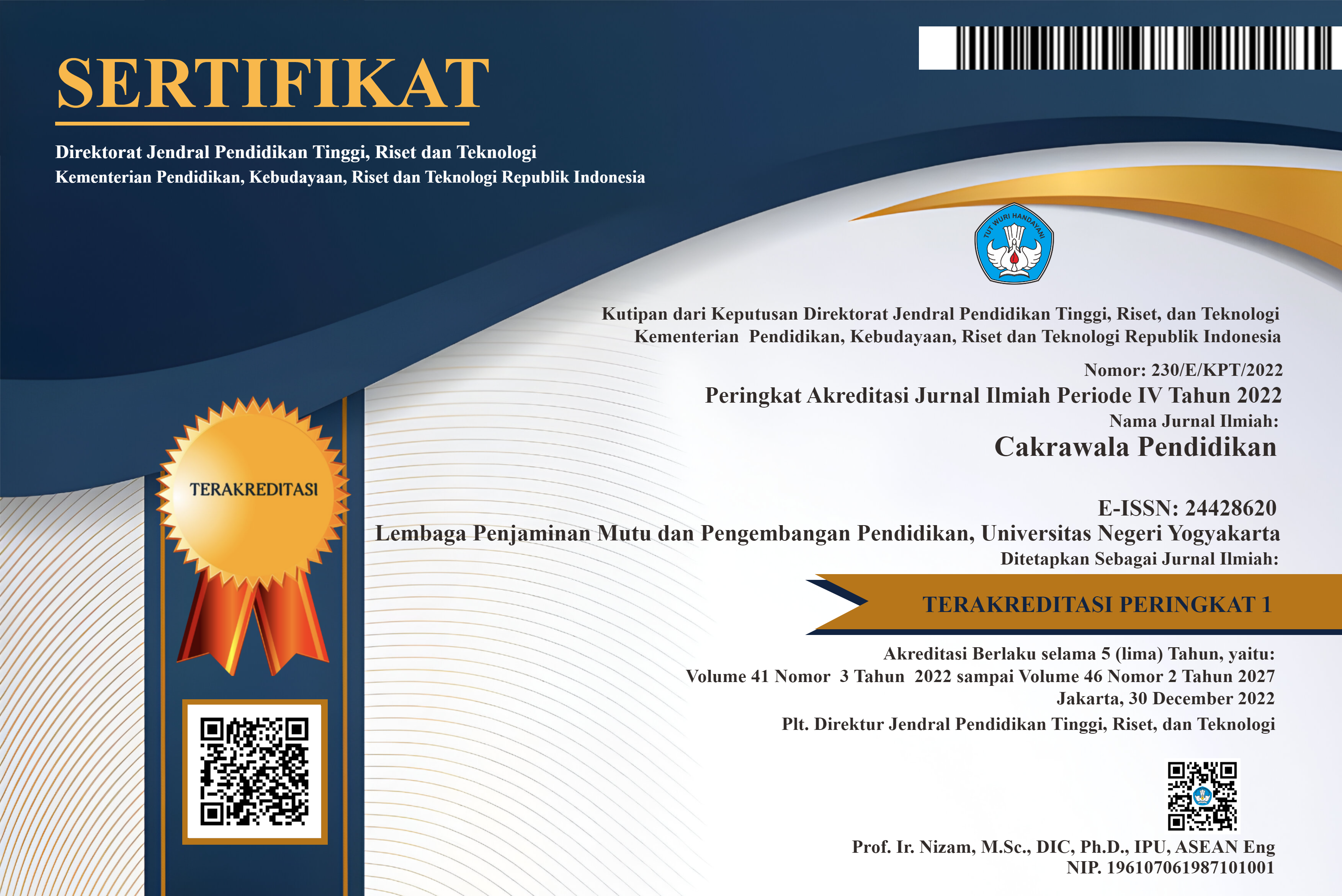
Jurnal Cakrawala Pendidikan, Jurnal Ilmiah Pendidikan, with ISSN: 0216-1370, is published by the Institute of Education Development and Quality Assurance (LPPMP UNY). Cakrawala Pendidikan has been recently has been re-accredited by Indonesian Ministry of Education and Culture decision Number 230/E/KPT/2022 which is valid for five years since enacted on 30 December 2022.