The effect of handball invasion game model on elementary students’ empathy: A sociocultural perspective
Downloads
This study aims to examine the effectiveness of a teacher's handbook designed for handball learning grounded in a sociocultural approach, with the objective of enhancing empathy among elementary school students. The research was motivated by global concerns regarding the decline in children's empathy, attributed to increased digitalization and limited direct social interactions, particularly in urban areas such as Sleman. Employing a quasi-experimental method with a non-equivalent control group design, the study involved two groups of students from different elementary schools. The experimental group utilized the teacher's handbook, while the control group received conventional learning. The study instruments included a validated and reliable empathy questionnaire, alongside observations of empathetic behaviors during the learning process. Statistical analysis revealed that the experimental group experienced a significant increase in empathy levels compared to the control group, with a mean difference of 6.2 points. The t-test indicated a significant value (p < 0.05), signifying a statistically significant difference between the two groups. These findings demonstrate that the sociocultural-based handball learning model is effective in fostering empathy among students and offers a practical solution for integrating character into physical education through developmentally appropriate game based learning in elementary schools.
Downloads
Altbach, P. G. (2022). Textbooks in American society: Politics, policy, and pedagogy. Albany, NY: SUNY Press.
Aris, H. (2016). Pengaruh model pembelajaran kooperatif terhadap keterampilan sosial siswa SD. Jurnal Pendidikan Jasmani Indonesia, 12(1), 45–52.
Azizah, N., Santosa, A. B., & Prasetyo, Y. T. (2024). Prevalensi kekerasan siber di sekolah dasar wilayah Sleman. Jurnal Psikologi dan Pendidikan, 9(1), 33–44.
Barrera-Gutiérrez, MI., Mantilla-García, JP., Estupiñán-Guamani, MA., Acosta-Bones, SB. (2026). Technological tools to foster empathy and emotional intelligence in early education. In: Garcia, M.V., Velastegui Hernández, R.S. (eds) AI and Computing in Industrial Education Handbook. Lecture Notes in Networks and Systems, 1512. Springer, Cham. https://doi.org/10.1007/978-3-031-97015-3_22
Barry, S. (2018). The effectiveness of TGFU in developing tactical awareness. International Journal of Physical Education, 55(2), 88–96.
Davis, M. H. (1983). Measuring individual differences in empathy: Evidence for a multidimensional approach. Journal of Personality and Social Psychology, 44(1), 113–126. https://doi.org/10.1037/0022-3514.44.1.113
Decety, J., & Cowell, J. M. (2014). The complex relation between morality and empathy. Trends in Cognitive Sciences, 18(7), 337–339. https://doi.org/10.1016/j.tics.2014.04.008
Eisenberg, N. (2007). Empathy-related responding and prosocial behavior. New Directions for Child and Adolescent Development, 2007(117), 47–52. https://doi.org/10.1002/cd.199
Goleman, D. (2016). Emotional intelligence: Why it can matter more than IQ. New York, NY: Bantam Books.
Goudas, M., & Magotsiou, E. (2009). The effects of a cooperative physical education program on students’ social skills. Journal of Applied Sport Psychology, 21(3), 356–364. https://doi.org/10.1080/10413200903026058
Hidayat, R., Raharjo, T. J., & Fitria, D. (2020). Pengembangan model pembelajaran jasmani adaptif untuk optimalisasi otak anak tunagrahita. Cakrawala Pendidikan, 39(3), 576–588. https://doi.org/10.21831/cp.v39i3.31578
Irmansyah, D., Sulaiman, R., & Wahyudi, A. (2020). Cooperative games dalam meningkatkan kemampuan sosial anak usia dini. Jurnal Pendidikan Anak, 7(2), 102–113.
Jolliffe, D., & Farrington, D. P. (2006). Examining the relationship between low empathy and bullying. Aggression and Violent Behavior, 11(5), 540–550. https://doi.org/10.1016/j.avb.2005.10.003
Jones, S. M., Bouffard, S. M., & Weissbourd, R. (2014). Educators’ social and emotional skills vital to learning. Phi Delta Kappan, 96(2), 62–67. https://doi.org/10.1177/0031721714553405
Kurniawan, D., Prabowo, R., & Hartati, E. (2018). Studi tentang kekerasan verbal di sekolah dasar. Jurnal Pendidikan Karakter, 8(3), 215–230. https://doi.org/10.21831/jpk.v8i3.24478
Lestari, N. A., & Nugroho, H. A. (2021). Pengetahuan guru tentang nilai-nilai karakter pembelajaran pendidikan jasmani sekolah dasar. Cakrawala Pendidikan, 40(1), 121–131. https://doi.org/10.21831/cp.v40i1.37845
MacPhail, A., Kirk, D., & Griffin, L. (2008). Throwing and catching the understanding: Teaching Games for Understanding in physical education. European Physical Education Review, 14(3), 285–303. https://doi.org/10.1177/1356336X08095671
Mediyawati, N., Lustyantie, N., & Emzir. (2019). MEDIA: Designing a model of IFL learning materials for foreign workers. Cakrawala Pendidikan, 38(1), 75–89. https://doi.org/10.21831/cp.v38i1.22245
Oboeuf, A., Garncarzyk, L., & Ria, L. (2023). Empathy and creativity in handball: A sociocultural approach. Physical Education and Sport Pedagogy, 28(1), 77–92. https://doi.org/10.1080/17408989.2022.2063567
Penn State Global. (2023). Activating empathy program. Pennsylvania State University. https://global.psu.edu/activatingempathy
Schonert-Reichl, K. A. (2011). Promoting empathy in school-aged children: Current state and implications for future research. Canadian Journal of Behavioural Science, 43(1), 1–6. https://doi.org/10.1037/a0022665
Slavin, R. E. (2006). Educational psychology: Theory and practice (8th ed.). Pearson Education.
Sutrisno, H., Wibowo, H. A., & Andriani, E. (2022). Upaya peningkatan kecerdasan emosi siswa sekolah dasar melalui pendidikan jasmani harmoni. Cakrawala Pendidikan: Jurnal Ilmiah Pendidikan, 41(2), 201–214. https://doi.org/10.21831/cp.v41i2.42068
University of Cambridge. (2024). Empathy week: Global education initiative. https://empathy-week.com
Vygotsky, L. S. (1978). Mind in society: The development of higher psychological processes. Harvard University Press.
Wright, P. M., & Craig, M. W. (2011). Teaching for personal and social responsibility in physical education. Research Quarterly for Exercise and Sport, 82(1), 25–36. https://doi.org/10.1080/02701367.2011.10599721
Copyright (c) 2026 Danang Pujo Broto

This work is licensed under a Creative Commons Attribution-ShareAlike 4.0 International License.
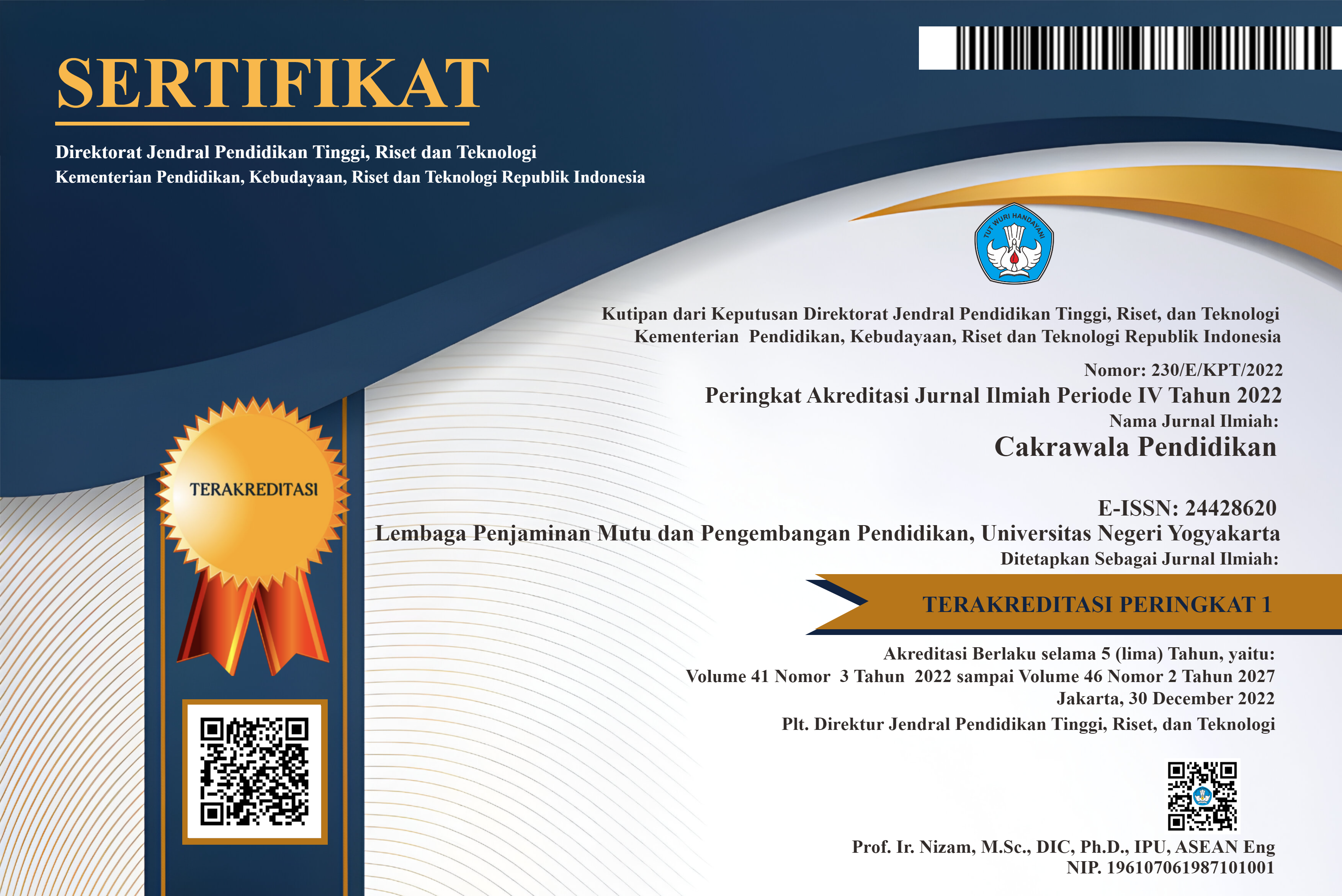
Jurnal Cakrawala Pendidikan, Jurnal Ilmiah Pendidikan, with ISSN: 0216-1370, is published by the Institute of Education Development and Quality Assurance (LPPMP UNY). Cakrawala Pendidikan has been recently has been re-accredited by Indonesian Ministry of Education and Culture decision Number 230/E/KPT/2022 which is valid for five years since enacted on 30 December 2022.